
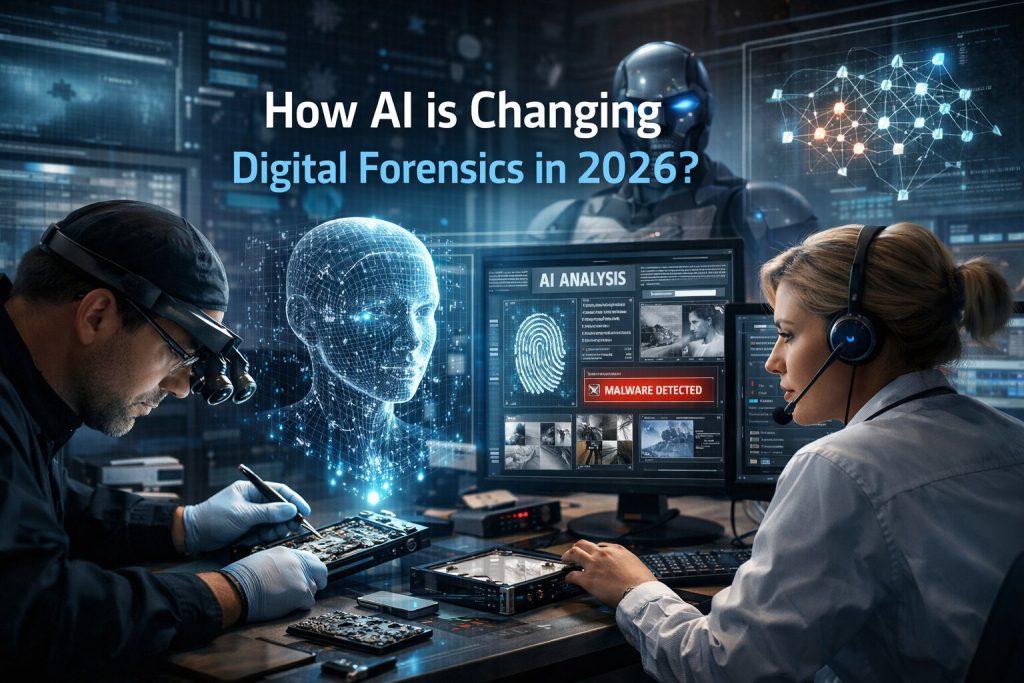
Artificial Intelligence (AI) is changing the way we work, live and interact. With automating tasks, enhancing decision-making and creating smarter and more efficient systems, AI is transforming industries and redefining future work.
AI in Digital Forensics is the future of crime investigation. Complex cybercrimes are solved in no time using AI tools. 2026 is the benchmark year where AI is transforming digital forensics in a new way.
What is Artificial Intelligence in Digital Forensics?
Digital Forensics involves collecting, analyzing and preserving digital evidence from devices like smartphones, servers and computers.
Earlier, these processes were manually done by the forensic experts and hence were time-consuming and prone to human error.
In 2026, AI tools for digital investigation are enhancing every stage of forensic investigation by automating data analysis, identifying anomalies, reducing investigation time and improving accuracy and reliability.
How are AI tools helping in combating Cyber Attacks?
From analyzing huge data sets to detecting hidden patterns in cyber-attacks, AI is helping investigators move faster, smarter and more accurately than ever.
- AI tools help detect unusual patterns in real time, helping identify potential cyber threats before they increase
- ML analyses vast data sets to quickly spot malware, phishing attempts and suspicious activities
- AI tools automate threat detection and response, reducing reaction time during attacks.
- AI tools monitor devices 24/7, thus strengthening endpoint security and blocking anomalies.
- Threat intelligence platforms use AI tools to predict and prevent emerging cyber risks.
- Automated incident response reduces damage and speeds up recovery.
Role of AI in Digital Forensics
- AI-Powered Data Analysis: Modern investigations deal with terabytes of data. Emails, logs, social media activity and cloud records create overwhelming volumes of information. AI solves this challenge by quickly scanning massive datasets, identifying relevant evidence and filtering out noise. Machine Learning in Digital Forensics can detect patterns that human analysts might miss, making investigations more efficient. This process, traditionally used to take weeks, can now be completed in a few hours.
- Intelligent Threat Detective: Using AI applications in digital forensics, the experts can predict future threats. By learning from previous cyber-attacks, AI systems can identify suspicious behavior in real-time, flag potential insider threats and detect malware patterns before they spread. This proactive approach is reshaping digital forensics from reactive investigation to predictive intelligence.
- Automation of Repetitive Tasks: Earlier forensic specialists used to spend hours on repetitive tasks like data sorting, log analysis and file categorization. AI automates these tasks, allowing the professionals to focus on strategic decision-making. Automating repetitive tasks reduces human error, ensures faster case resolution and increases productivity.
- Increased Accuracy and Reduced Bias: Human errors and bias were the main challenges in forensic analysis. AI improves accuracy by applying a consistent analysis method, eliminating subjective interpretation and cross-verifying data across multiple sources.
- Deep Learning in Cyber Forensics: Cyber criminals are becoming more advanced using encryption, anonymization and AI themselves. AI-driven forensic tools are helping investigators break down complicated attack patterns, trace digital footprints across networks, analyse ransomware behaviour, and identify phishing campaigns.
- Cloud Forensics: With the rise of cloud computing, data is no longer confined to physical devices. AI plays a key role in cloud forensics by monitoring distributed environments, detecting unauthorised access and analysing cross-platform data. The investigators can track evidence from any remote place.
Role of Human Expertise in AI Digital Forensics 2026
AI has become a robust force in digital forensics in 2026. AI –based forensic analysis helps in automating data analysis, detecting anomalies and accelerating investigations.
However, despite these, human expertise remains at the core of effective forensic practice. AI lacks contextual understanding, ethical judgment and legal awareness, and thus, the role that professional digital forensics experts play is key.
- Interpretation: Human experts are important for interpreting AI-generated insights. AI tools cannot fully understand the context behind user behavior, intent or situational nuances. Forensic specialists bring critical thinking into the process, validating AI findings and ensuring that conclusions are accurate and relevant in the case.
- Integrity: The forensics experts maintain the integrity and admissibility of the digital evidence. Legal systems require strict adherence to forensic protocols, chain of custody and documentation standards. AI tools help gather evidence and analysis, but only trained professionals can ensure that these processes meet legal requirements and stand up in court.
- Ethical Decision Making: Ethical decision-making is an area where humans stand ahead of AI tools. AI Digital Forensics Tools in 2026 operate based on data and algorithms. This may introduce bias or misinterpretation. Experienced digital forensics experts help identify these limitations, ensuring that investigations remain fair, unbiased and compliant with privacy laws and ethical standards.
- Intuition: Cybersecurity threats are evolving, often involving complicated and unpredictable tactics. Digital Forensics experts bring their experience and intuition that AI cannot replicate. The professional specialists can adapt strategies, think creatively and respond to new types of cyber-attacks that fall outside predefined algorithms.
- Strategic Analysis: AI handles repetitive and time-consuming tasks such as data sorting and pattern recognition, while the experts focus on strategic analysis and decision-making. This collaboration leads to quick investigations without compromising quality or accuracy. The future of digital forensics lies in collaboration between experts, intelligence, and AI.
- Digital Forensics with AI cannot be ignored if businesses aim to stay ahead in the rapidly evolving landscape. To stay secure and competitive, businesses must invest in AI-powered forensics tools, train teams in AI-driven investigation methods, strengthen cyber security frameworks and ensure data protection laws compliance.
AI is redefining Digital Forensics in 2026. Speed, accuracy and predictive intelligence are important. Organizations and the digital forensics investigators who have integrated artificial intelligence will have a clear advantage in combating cyber threats and ensuring digital trust.
Do not wait for a Cyber incident to explore your vulnerabilities. Leverage AI in your digital forensics today and protect your data, strengthen investigations and stay ahead of changing threats.
FAQs
- Can Artificial Intelligence replace human experts in digital forensics?
No, AI supports investigations, but human expertise is important for interpretation and legal validation. TCG Forensics’ investigators leverage AI tools in their work process to ensure accuracy, precision and fast processing. - Why is human judgment important in AI-driven forensics?
Investigators provide context, ethical decisions, and ensure accuracy beyond algorithmic analysis. - How do AI and human expertise work together in digital forensics?
TCG Forensics integrates AI in analysis. AI handles data processing while humans focus on analysis, decision-making and case strategy.
About the Author
TCG Forensics is a trusted digital forensics and cybersecurity firm, delivering accurate and court-ready evidence. The professional forensic experts blend AI tools with their experience and expertise to uncover critical insights and solve complex digital cases.
The brand is committed to integrity, precision, and helping organisations stay secure in an evolving digital landscape.