In the digital world today, cybercrime, fraud, data breaches, theft, intellectual property and legal issues are common. Electronic evidence thus plays a key role in investigating these issues. However, digital evidence is only valuable if its authenticity and integrity are proven. Here is where the digital chain of custody becomes important. A properly maintained chain of custody ensures that digital evidence is admitted in court and protected from unauthorized access or tampering throughout the investigation process.
What is Chain of Custody in Digital Evidence?
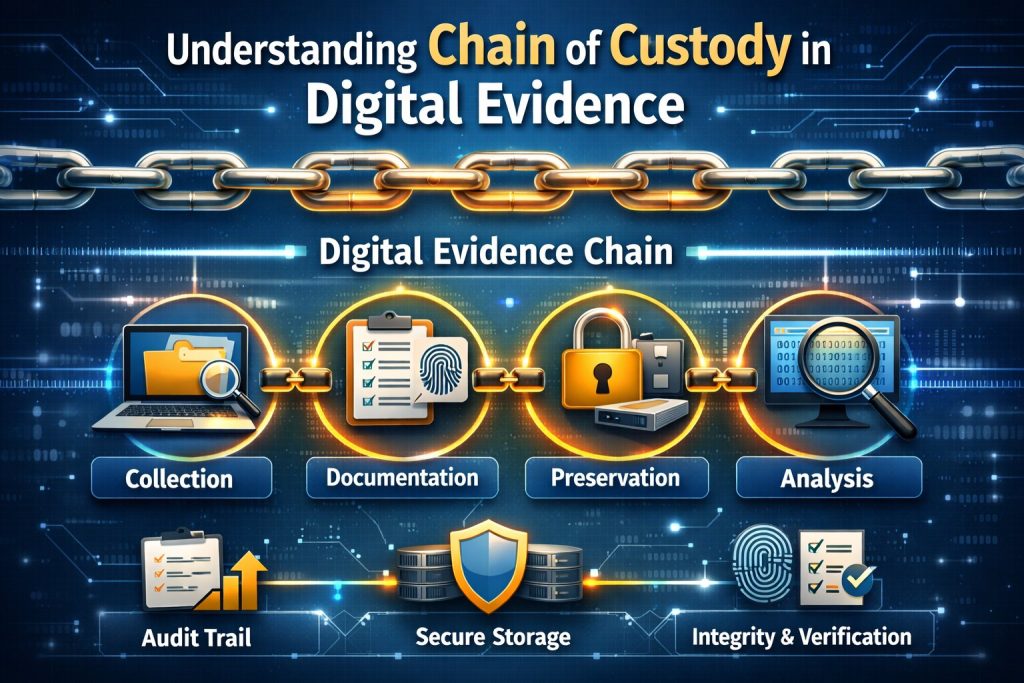
The Chain of Custody for digital evidence is the documented process of collecting, handling, transferring, storing, analyzing and presenting electronic evidence. It provides a detailed record of many important aspects, including-
- The name of the evidence collector
- Time of collection
- Storage area
- The name of the person who accessed it
- What actions were performed on it
The documentation helps establish the authenticity of digital evidence and demonstrate that it has remained unchanged from the time of collection to its presentation in legal proceedings.
Importance of Chain of Custody in Digital Evidence
The Chain of Custody in Digital Evidence is important because it establishes a clear and documented history of how electronic evidence was collected, handled, stored, transferred and analyzed throughout the investigation process.
This process maintains integrity, authenticity and reliability of the digital data by ensuring that no unauthorized modifications, tampering or contamination will occur. A properly maintained chain of custody provides transparency and accountability, allowing legal professionals, investigators and courts to check that the evidence was not changed from the time it was acquired. Maintaining the chain of custody in digital evidence is important to make it admissible in legal proceedings to strengthen the case.
Understanding Chain of Custody in Digital Evidence
Chain of Custody in Digital Forensics is very important. Any gap or inconsistency in documentation can raise questions about the evidence’s credibility, and it may result in its rejection during legal proceedings.
- Digital Evidence Custody: The main objective of the chain of custody is to preserve the integrity of digital evidence. The digital forensic experts must ensure that the data remains exactly as it was when originally collected. This is achieved through forensic imaging, cryptographic hash values and secure storage procedures. Any alteration, no matter how small it is, changes the hash values and indicates potential tampering. By documenting and verifying hash values throughout the investigation, forensic experts can prove that evidence remains intact.
- Digital Evidence Collection Process: The collection process is one of the most important stages in digital investigations. Investigators must follow standardized forensic procedures to avoid changing the original evidence. Specialized forensic tools are used to create exact copies of hard drives, mobile devices, cloud data and other digital sources. In this stage, the forensic specialists record key details including data and time of collection, location where evidence was found, device specifications and serial numbers, name of person collecting evidence and methods and tools used during acquisition.
- Chain of Custody Documentation: Documentation is important process in forensic investigations. The digital evidence passes through many hands during an investigation. It may be transferred between forensic analysts, legal teams, law enforcement agencies and expert witnesses. A complete transfer record should include name of the person transferring the evidence, name of recipient, data and time of transfer, purpose of access or transfer and condition of evidence at the time of transfer. It is important to maintain detailed audit trail to establish accountability ensuring transparency throughout the investigative process.
- Ensure Legal Admissibility: For digital evidence to be accepted in court, investigators must show that the proper forensic procedures are followed. Courts require assurance that evidence has not been altered, manipulated or mishandled. A documented chain of custody shows the origin of evidence, the person who handed it, the procedure and place of its storage, analysis conducted and modifications occurred if any. Strong electronic evidence chain of custody documentation strengthens the credibility of expert testimony and increases the likelihood that evidence will be deemed admissible.
- Prevent Tampering or Contamination: Digital evidence is highly vulnerable to accidental modification or intentional tampering. Even connecting a device to a system can change the metadata or timestamps. To prevent contamination, the experts integrate strict security measures like –
- Write blocking devices
- Restrict access to authorized personnel
- Encrypting evidence storage locations
- Maintaining secure evidence lockers
- Logging all access attempts.
Such safeguards help preserve the original state of evidence and protect the integrity of the investigation.
- Digital Evidence Preservation: Preservation is an ongoing responsibility throughout the investigation lifecycle. It is very important to keep the digital evidence in a secure place from the moment it is collected until the case is solved. The professional forensic experts follow the best practices of preservation, including –
- They create forensic copies instead of working on originals
- Maintain verified backup copies
- Store evidence in secure environments
- Conduct regular inventory checks using hash verifications
- Follow established forensic standards and legal requirements
Proper preservation of evidence ensures it is reliable and defensible even during lengthy investigations.
Case Study
An MNC found its confidential product design leaked to its competitor. The organization’s cybersecurity experts identified suspicious activity on an employee workstation and immediately initiated a forensic investigation. The forensic team created a bit-by-bit forensic image of the employee’s hard drive using standard forensic tools. Hash values were generated and documented at the time of collection. The original device is sealed and stored securely. The investigators analyzed the forensic copy. They recorded every transfer of evidence, and the access logs documented who handled the evidence and why.
Their analysis revealed that sensitive files were copied to an unauthorized cloud storage account before the employee resigned. Thanks to the cyber chain of custody, the organization successfully presented the evidence during legal proceedings; it was accepted by the court. The company was able to prove unauthorized data theft.
The Chain of Custody form for digital evidence is the pillar in legal investigations and digital forensics. Work with a professional forensic expert to ensure you have a robust chain of custody to protect the value and reliability of digital evidence in case of any cyber threat.
FAQs
- What information do digital forensic experts include in the chain of custody?
Details like evidence collection, storage transfers, access logs, dates, time, locations and persons handling the evidence. Work with TCG Forensic to ensure a well-documented chain of custody, protecting evidence integrity and supporting successful legal outcomes. - What happens if the chain of custody is broken?
It creates doubt about the evidence’s authenticity, leading to exclusion of evidence from legal proceedings and even challenges in court. - How do forensic experts verify that digital evidence has not been altered?
TCG Forensic Experts use cryptographic hash values like SHA-256.
About the Author
With more than two decades of experience in digital investigations, cybercrime analysis and evidence management, TCG Forensics delivers reliable and court-admissible digital forensic services. Using advanced technologies, the team of forensic experts conducts investigations and uncovers important digital evidence.